Grammar Checker: Check, Correct and Improve Your Writing
Grammar mistakes can make otherwise good writing distracting or difficult to understand. A grammar checker can help identify common grammatical errors, but understanding how grammar checkers work and when to use one makes you a better writer.
What is A Grammar Checker?
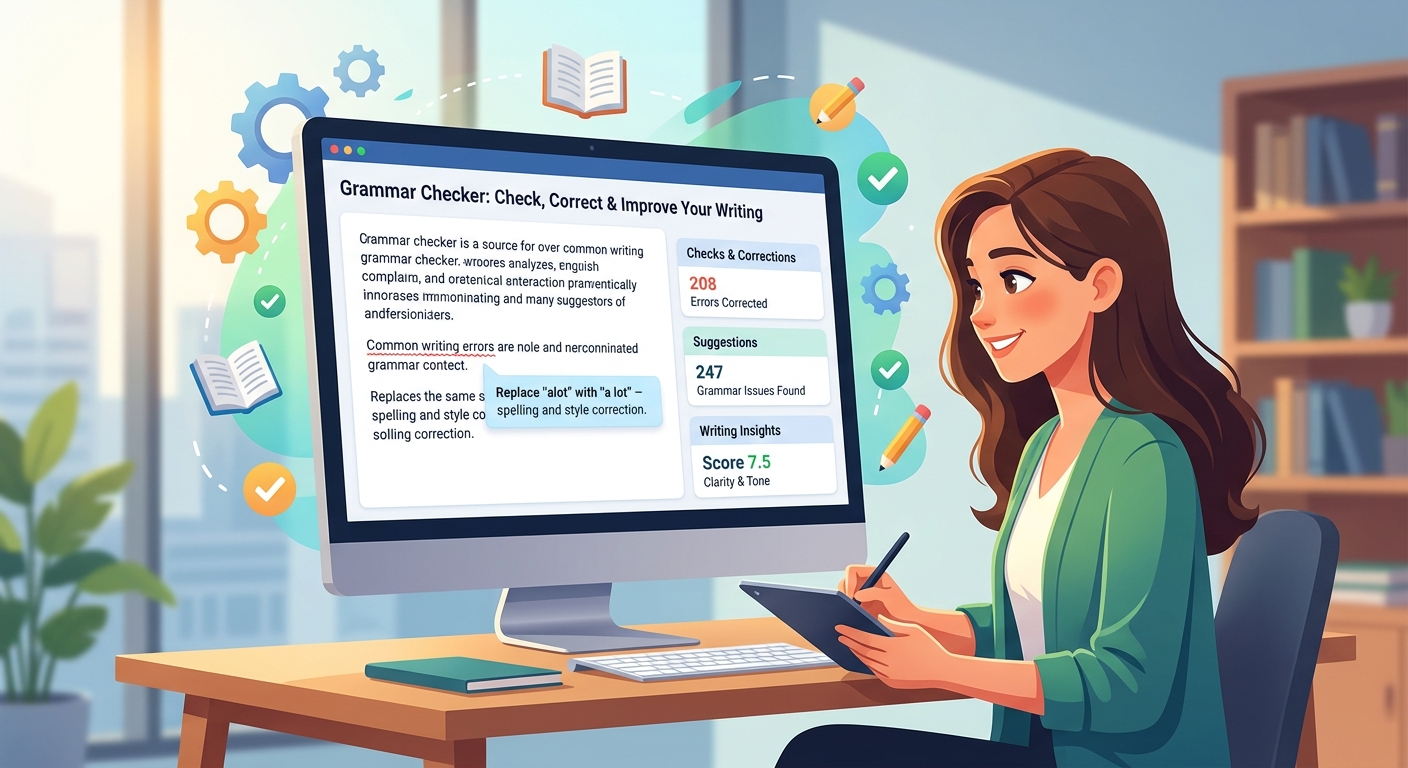
A grammar checker is an editing and proofreading tool that scans text to detect and fix errors in grammar, spelling, punctuation, and sentence structure.
What Do Grammar Checkers Do?
Grammar checker tools:
• Catch misspelt words and incorrect word choices.
• Detect and add missing commas, apostrophes, periods, etc.
• Identify incorrect sentence structures and suggest clearer styles of writing.
• Correct subject-verb agreement and verb tenses.
How Do Grammar Checkers Work?
Grammar checkers work in three methods —
• Rule-based method
• Statistical & Machine-Learning method
• Modern Deep Learning & AI method
Traditional grammar checker tools process text through rule-based systems where they rely on a massive list of pre-written grammatical laws and dictionary definitions.
Rule-based tools can be rigid and might accidentally flag correct sentences if they are too complex.
Then there’s the Statistical and Machine Learning method that first reads millions of sentences to learn how words are naturally grouped together. By studying these patterns, the system can calculate the probability of specific word sequences.
If a text has a very low probability on the pattern recognition scale, the system might flag it as grammatically flawed.
For example, this sentence is correct: “I caught some fish yesterday”, and shouldn’t be flagged by the system.
But if the sentence is, “I cot some fish yesterday,” a statistical system will flag it because the probability of the word “cot” in this sentence position is incredibly low, even though the word “cot” is a legit vocabulary word.
However, modern grammar checker tools take a combined approach by mixing rule-based and statistical methods with modern Deep Learning and NLP (Natural Language Processing) models.
The approach doesn’t treat the text as separate words; it reads the text as a whole sentence or paragraph to understand the actual meaning and context to identify errors.
One thing that AI-based models do but traditional models don’t is that they not only identify and edit the incorrect text portions, but also improve the text by rewriting passive sentences, replacing weak phrases with stronger ones, and tweaking tones as well.
Many popular grammar checker tools use the combined method to edit grammar because it’s more flexible, faster, and more efficient than any single approach in terms of analysing complex text, understanding meaning, and identifying unintentional errors.
Why Grammar Matters for Clear Communication
Grammar functions as the core of human communication. Its main goal is to make communication clear, confusion-free, and fast to process.
Without grammatical rules, it would be difficult to convey how words fit together and what they exactly mean in certain contexts— ultimately leading to misunderstanding in daily life, school, and professional areas.
Here’s how grammar helps you —
1. Prevents confusion by introducing proper sentence structures to ensure readers/listeners understand exactly what you’ve said.
2. Removes distractions by removing errors and allowing people to focus on what you’re saying.
3. Guides readers with proper punctuation and word order on how to understand something in the exact way you wanted.
4. Builds trust by showing your attention to detail and professional competence.
5. Supports learning by helping you think critically and express complex ideas confidently.
Common Grammar Mistakes to Avoid
People often make various grammatical mistakes while communicating through writing or speaking.
Here are some of the common grammar errors to be careful about:
• Homophone mix-ups: They’re/Their/There; Your/You’re; It’s/Its; Affect/Effect; Than/Then, etc.
• Punctuation errors: Comma splice, missing Oxford comma, incorrect use of apostrophes, etc.
• Pronoun and preposition slips: I vs Me; Could’ve vs Could Of; Who vs Whom, etc.
Are You Using These Fatal Incorrect English Phrases? ⟶
Key Benefits of Using An Online Grammar Checker
Using a grammar checker tool provides clear advantages: it saves time, ensures your message is completely clear, boosts productivity and professional credibility, and teaches you better ways to communicate.
Most notable benefits of a grammar checker tool include:
• Instant correction: flags mistakes in real-time as you write, keeping your writing polished and error-free from the beginning.
• Error prevention: Detects micro errors such as typos, wrong article usage, plural mix-ups, etc., that the human eye might not catch immediately.
• Vocabulary enhancement: Replaces weak, repetitive words by suggesting more suitable synonyms.
• Skill improvement: Some grammar checkers explain why a word/phrase was flagged, helping you consciously avoid the mistake in the future and become a better writer over time.
How to Use Rewritertools Grammar Check Tool
Rewritertools’ Grammar Check is a free, advanced grammar checker tool. It allows you to fix grammatical errors and optimise your writing in 80+ languages.
Here’s how to use it:
Step 1: Go to Grammar Check
Step 2: Enter your text and select the language
Step 3: Click “Fix”
Step 4: See the fixed text in the text box on the right.
Grammar Checker Vs. Manual Editing: When to Use Each
When writing, both grammar-checking tools and manual editing matter. Tools are fast and efficient, and they can detect mistakes that might escape human eyes or take a long time to identify. However, no matter how efficient these tools are, a document may still require human judgment before final submission.
When Grammar Checkers Are the Better Option
When you have high-volume, low-stakes texts and tight timelines, online grammar checkers are your most effective option. They’re great at proofreading and basic polishing where deep editing is not needed.
When Manual Editing is the Better Option
When your goal is not only proofreading or optimising sentence structures but also checking factual correctness, context, depth, tone, and the overall flow of the content, manual editing is the better option.
It’s practically valuable when your document demands thoughtful judgment, nuanced changes, or additional layers that tools might overlook.
Tips for Grammatical Error-Free Writing
To write clear, grammatically error-free text, you need to combine a few mechanical habits with systematic proofreading into your workflow.
• Keep sentences simple enough and easy to understand for your target readers.
• Maintain consistent verb tense (past/present) throughout your writing.
• Make sure singular subjects have singular verbs and plural subjects have plural verbs.
• Use active voice to make your writing clearer unless passive voice is more appropriate for the context.
• Read aloud to catch awkward phrasing, out-of-place commas, and poor flow easily.
• Read backwards to really focus on individual words, grammar, and spelling.
• Check and recheck even after using a grammar checker tool to ensure human judgment makes the final decision.
FAQs
Should I trust every suggestion from a grammar checker?
No. A grammar checker is a useful editing tool, but it may false-flag grammatically correct text with unclear context, native slang, complex sentence structure, etc. Before accepting a suggestion, read the revised sentence and check whether it preserves your original meaning and fits the context
How accurate are grammar checkers?
Modern grammar checkers can catch many common issues, including spelling mistakes, punctuation errors, subject-verb agreement, misplaced words, and some sentence-structure problems. However, their accuracy varies depending on the tool, the complexity of the writing, and the context. For important documents, it’s better to combine automated checking with careful human review.
What does a grammar checker check?
It depends on the tool, but most grammar checkers look for more than basic grammar errors. They may check spelling, punctuation, sentence structure, verb tense, subject-verb agreement, word choice, and common usage errors. Some advanced tools also provide suggestions for clarity, conciseness, tone, and readability.
Can a grammar checker detect all grammar mistakes?
No. Grammar is highly dependent on context, meaning, and intention, which can make some errors difficult for automated tools to identify. A sentence may look unusual to a tool but be perfectly correct in context, while a subtle error may go unnoticed. This is why proofreading your writing yourself, or having someone else review it, is still important, especially for academic, professional, or high-stakes content.
What is the difference between a grammar checker and a spell checker?
A spell checker primarily looks for misspelt words and typographical errors. A grammar checker goes further by examining how words are used and how sentences are constructed. For example, a spell checker may recognise that “They was late” contains correctly spelt words, while a grammar checker can identify the subject-verb agreement error and suggest “They were late.”