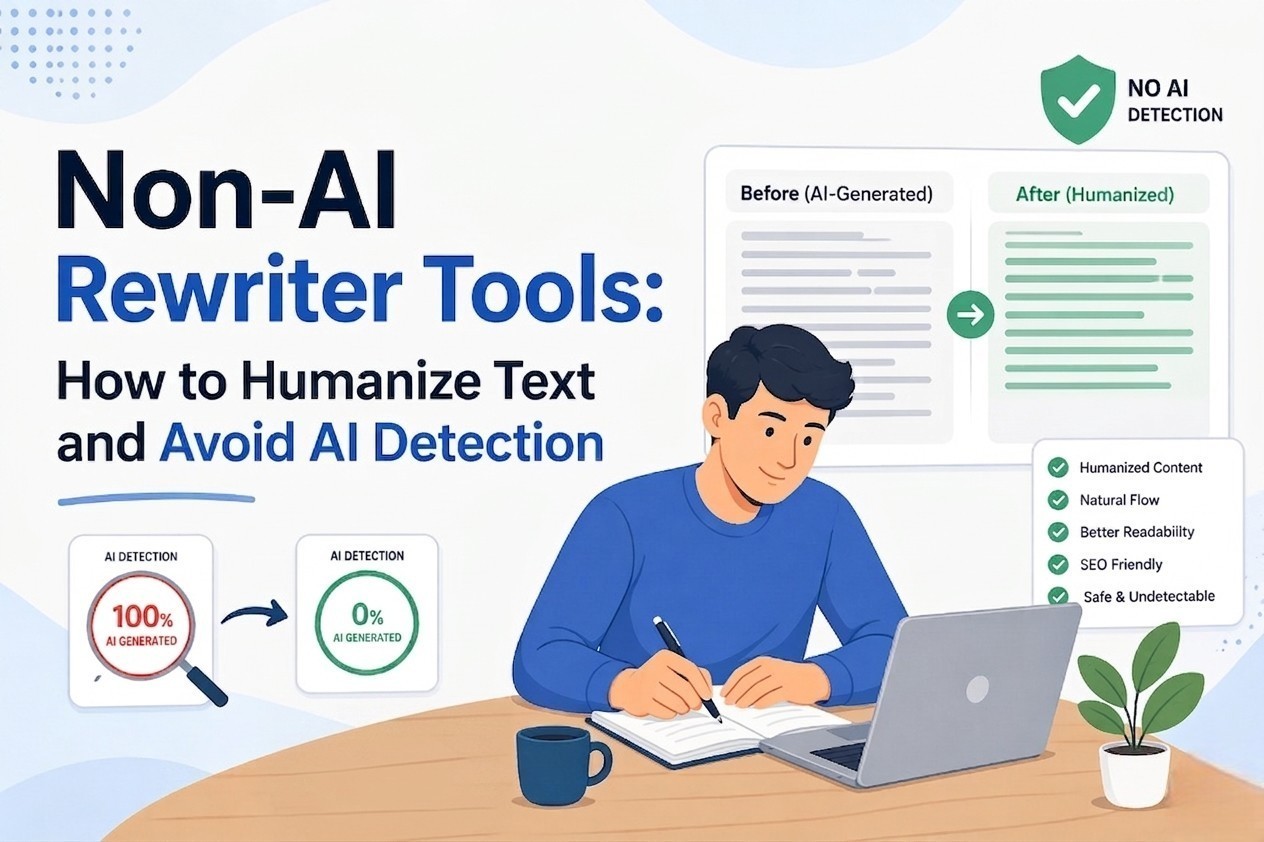
Non-AI Rewriter Tools: How to Humanize Text and Avoid AI Detection
The widespread use of generative models has introduced AI fatigue for content creators. When blog posts, articles, and academic writing start to sound like they all came from the same system, readers lose interest, and the content gets flagged by AI detection tools.
If you need to rewrite text without triggering AI detectors or losing a natural tone, non-AI rewriter tools are still one of the most dependable options.
What is a Non-AI Rewriter Tool?
A non-AI rewriter tool or traditional paraphrasing software is a text paraphrasing system that uses fixed rules, synonym databases, and manual logic instead of machine learning models.
While AI models depend on predictions and learned patterns, non-AI tools rewrite content using predefined language rules.
Key characteristics of non-AI text rewriters:
- Uses synonym replacement and sentence restructuring
- Follows grammatical rules, not predictive models
- Produces more “human-like randomness” in phrasing
- Less likely to be flagged by AI detection systems
How Do Non-AI Text Rewriters Work?
Non-AI text rewriters rely on deterministic processes:
- Synonym substitution: Replaces words using a fixed thesaurus database
- Sentence restructuring: Changes sentence order or structure
- Grammar rules: Maintains readability without generative AI
- Pattern-based rewriting: Applies predefined templates/rules
Why Use An AI-Free Rewriter Tool?
AI tools are fast, but overuse creates predictable content — similar structure, repeated phrasing, and uniform tone. Over time, the content feels generic and less engaging.
Another challenge is detection. Tools like Turnitin and QuillBot can flag AI-generated text, leading to extra effort to rewrite and humanize it.
How Non-AI Tools Fix the Problems:
Non-AI rewriter tools are most useful when your priority is control and natural output. Instead of generating content in “AI-style”, they support your writing process by removing rigid patterns and giving you flexibility to refine the text yourself.
- Reduce predictable AI patterns
- Give you more editing control
- Fit better into manual writing workflows
How to Bypass AI Detection
To avoid AI detection, you need to recognize the telltale signs of AI in your drafts. AI detectors look for patterns like "uniformity" (sentences that are all the same length) and "predictability" (using the most common word choice every time).
To bypass these signals, you need to:
- Vary sentence structure: Mix short, punchy sentences with longer, descriptive ones.
- Inject personal perspective: AI can’t share a genuinely personal experience.
- Remove repetitive transitions: Make sure there are no repetitive or unnecessary phrases in your text.
- Use a non-AI tool: Traditional tools will retain your writing style while refining the text.
How to Rewrite Without AI
Over-reliance on AI in writing has made many writers lose their edge and personal writing style. So much so that, after using AI tools for so long, many writers struggle with finding their own voice, leading to generic, ready-made output.
This leads writers to doubt themselves: Can I ever write without AI again?
If your goal is fully human-like content, combine tools with manual editing.
- Start with your original content
- Use a non-AI rewriter for base paraphrasing
Then manually:
- Adjust sentence flow
- Add personal tone
- Break predictable patterns
- Re-read for clarity and natural rhythm
How to Humanize Gemini, Claude, or ChatGPT Text
You don’t have to ditch AI from your workflow.
Sometimes, when you don’t have enough time to write by yourself, you can definitely use AI to draft your first copy.
In fact, you’ll get the best outcome when you combine AI ease and human decision-making together.
So, once you produce your content with Gemini, ChatGPT or any other AI rewriter tool, follow the next steps to humanize it:
- Rewrite sections using a non-AI text rewriter
- Replace generic phrases with specific examples
- Add subjective commentary or nuance
- Break linear structure
Finding the Best Free Non-AI Rewriter Tool Online
Not all tools labelled “rewriters” or “paraphrasers” are non-AI, so choosing the right one matters.
When searching for non-AI text rewriters online, focus on simplicity and naturalness over generic automation.
Look for these features:
- Basic paraphrasing engine (not AI-powered)
- Clean interface for manual edits
- Affordable or free access
- No “AI writing” claims
When Should You Use An AI-Free Text Rewriter Tool?
Use a non-AI rewriter tool when:
- You need to avoid AI detection
- You want full control over phrasing
- You prefer manual editing workflows
- You’re working in academic or sensitive environments
Conclusion
AI tools are faster, but non-AI tools are safer and more controllable.
Non-AI rewriter tools offer a practical way to paraphrase content using rule-based methods rather than AI. They help lower the chances of AI detection while giving you more control over how your content reads. When combined with manual editing, they produce the most natural results, making them especially useful for students, bloggers, and professional writers who value clarity, originality, and control.